Building Better
Building Better
Decision Making
Teams
What Eli Does
Eli Mina specializes in chairing contentious meetings, using rules of order in a pragmatic and sensible manner, and informed decision making. In business for more than three decades, Eli has offered his clients sage advice and problem solving services, and he leads high impact training sessions.
Eli is calm, soft-spoken, yet a highly effective meeting chair. He is an engaging and compelling workshop leader and public speaker, and a seasoned expert on Rules of Order (PRP, CPP-T).
Eli helps his clients transform their meetings from potential chaos, confusion and acrimony into orderly and well focused deliberative assemblies, where three key goals are met:
- A level playing field, where all attendees share their expertise and learn from the wisdom of others
- A sensible allocation of time
- Judicious and informed decisions, seeking to optimize organizational benefits and reduce risks
Eli’s clients come from:
Local governments
Boards of Education
Indigenous communities
Educational institutions
Credit Unions
Labor Unions
Regulatory bodies
Law firms
The not-for-profit sector
In Eli’s Own Words
It’s been said: If the only tool you have is a hammer, every problem will look like a nail. In my world this phrase can mean: If the only tools you have are rules of order, every problem can look like something that requires a motion, an amendment, a point of order, or an appeal from the Chair’s ruling.
Although I am an expert on Robert’s Rules of Order Newly Revised (RONR), I openly acknowledge that RONR’s more than 700 pages of rules can be frustrating, confusing and intimidating. There are also instances when rules are used excessively or manipulatively, which can cause an erosion of trust, flawed decisions, heightened risks, and even the demise of a great organization.
With this in mind, I always seek to apply rules in a manner that advances common sense: meaningful engagement of participants, effective time management, and informed decision making. Indeed, even RONR (12th edition, section 47) speaks about common sense: “… any presiding officer will do well to bear in mind that no rules can take the place of tact and common sense on the part of the chair…”
With the above phrase in mind, I apply just the required amount of rules of order in meetings, and I seek to employ common sense in the face of complex and contentious issues. Before I suggest a procedural approach, I ask questions that can identify the problems at hand and their root causes. My clients have found this approach to be pragmatic, enlightening and liberating.
On a related but lighter note, a workshop participant wrote this note to me at the end of a training session: “Eli, I just wanted you to know that I very much appreciated your emphasis on a common sense use of rules of order. I should tell you that a friend of mine shared this phrase with me: `Unfortunately, common sense is the least common of all the senses’…” How true…
Interactive Training
Robert’s Rules & Responsible Governance
This workshop will assist your Board and Management in conducting productive meetings, using rules of order sensibly and intelligently, and achieving excellence in decision-making. You will identify helpful habits that should be embraced and potentially damaging habits that should be abandoned. This workshop builds, in part, on Eli Mina’s book `101 Boardroom Problems and How to Solve Them.’ Topics include:
- Rules of Order and the Common Sense Factor
- Fundamental rules for debates: The OFEEDS acronym
- Roles of the Chair and Participants in ensuring effectiveness
- Main motions, amendments, `tabling’, quorum, voting issues
- Knowledge-based decision-making: goals, challenges
- Governing in the face of conflicting views, values and principles
- Consensus versus majority decision-making (`board solidarity’)
- Balancing organizational v. constituency interests (`two-hats’)
- Interactions between Elected Members and Management
- Public input, community consultation, and related interactions
Publicly Scheduled Virtual Workshop:
“Robert’s Rules of Order – Demystified”
A one day virtual workshop with Eli Mina
Date: Tuesday, October 1st, 2024
Time: 9 a.m. to 4 p.m. Pacific Time
Sponsored by the
Continuing Legal Education Society of British Columbia (CLEBC).
You may also contact Jessica Hodgins by email at JessicaH@cle.bc.ca.
Supporting Successful Meetings
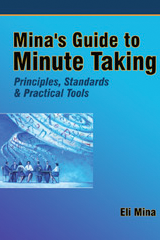
Supporting meetings can be a demanding and complex job. It starts with preparing agendas, motions, scripts and reports, continues with logistical details, and ends with producing minutes. This workshop provides administrative and management staff with tools and ideas to effectively support meetings of elected officials. It builds, in part, on Eli Mina’s book `Mina’s Guide to Minute Taking.’ Topics include:
- Preparing agendas for open meetings and closed meetings
- Drafting motions or resolutions for the group’s consideration
- Minute taking issues to watch for
- Three content options for minutes
- Minutes approval process and its impacts
- Impacts of access requests & confidentiality on agendas, minutes
- Preparing reports, presenting them, and taking tough questions
- Providing rules of order input on voting, motions, `tabling’, etc.
- Core principles for debates; staff’s roles in implementation
- Is it acceptable for staff members to speak up in meetings?
If you are interested in customized in-house training sessions, contact us.
Self-Paced E-Training
Minute Taking Online Tutorial

The tutorial includes seven modules, to be completed within thirty days. The tutorial is self paced and does not include any lectures. For each of the seven modules, review the corresponding chapter in “Mina’s Guide to Minute Taking”, and then log in and answer a series of questions (partly based on the book), and compare your reply to Eli Mina’s reply.
Sample Questions
Price: $300
View Course Information
Minute Taking Online Tutorial
Outcomes
As a result of taking the Minute Taking tutorial, you will:
- Understand minute taking concepts and key principles.
- Identify options for minute taking standards for the organization.
- Learn to prepare concise, clear and logical minutes for informal meetings.
- Understand how formal meeting procedures should be recorded in minutes.
- Appreciate the impacts of privacy and access to information on meetings and minutes.
- Understand the minutes approval process and its impacts.
- Develop a positive working relationship with your group’s Chair and members.
Textbook
The textbook for this course is “Mina’s Guide to Minute Taking“.
Making Meetings Work Podcasts

This suite of podcasts and tip sheets is designed to help you improve your skills as a meeting chair or member. Eli Mina, Meeting Mentor and Registered Parliamentarian, offers guidance and advice regarding all aspects of planning, conducting, and managing effective meetings. It is a must-listen for all new and experienced board, council and committee chairs and members.
Price: $75
View Course Information
Making Meetings Work
Part 1 – Building the Foundation for Effective Meetings
Learn how to develop a clear and compelling sense of purpose, ensure that meeting participants are effective contributors, and establish ground rules for interaction during the meeting. The tip sheet outlines how to create a foundation for effective meetings to maximize committee effectiveness and productivity.
Part 2 – Planning and Agenda Design
Explore the steps involved in building a meaningful and productive meeting agenda in Part Two of the series. The tip sheet offers ideas and checklists for planning an effective meeting.
Part 3 – Roles of the Meeting Chair
Part Three of the series explains how to strategically manage time, people and the meeting’s agenda. Tools are given for chairing meetings effectively, bringing out the best in members, and orchestrating productive discussions.
Part 4 – Avoiding Chaotic, Adversarial & Aimless Meetings
Using a case study, Part Four analyzes approaches and techniques that can be utilized to create productive and enjoyable meetings.The tip sheet provides suggestions and strategies for maintaining (and restoring) a productive meeting environment.
Part 5 – Rules of Order and Minutes: Key Points
Part Five reviews useful tools for maintaining the appropriate structure and formality required for democratic decision-making. It offers guidance for using meeting procedures and minutes to sustain and promote a meeting environment that is democratic, creative, inclusive, transparent and accountable.
Part 6 – Answers to Your Questions
Eli Mina responds to questions on handling common meeting challenges including participation, follow-through, time management, focus, and related dilemmas.
Books & Publications
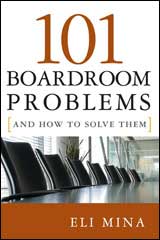
101 Boardroom Problems and How to Solve Them
Table of Contents
Read an Excerpt
Read a Review
Price: $30
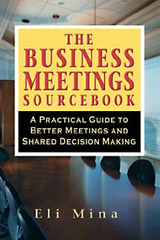
Eli Mina’s Article Collection
E-Book Available by July 31st, 2021
Price: $25

New Publication Coming Soon
Testimonials
Here are highlights of what some of Eli’s clients have said about his work:
“Eli, on behalf of the Board and Management, thank you very much for an inspiring training session. I checked with those who attended, and each of them felt better informed about their Board responsibilities. The humble and unassuming manner you possess, together with the brilliant way you are able to put tough points across with absolute clarity, is exceptional. You are indeed a true virtuoso at your craft.”
“As a new Mayor with a new Council, I can say that all of us (and our community) have greatly benefited from your sage advice. It makes me proud to be the leader of my Council, and I am very thankful for your teachings and words of wisdom.”
“You practiced what you preached and ran the seminar as a productive yet inclusive meeting. Time went by very quickly. People who usually find excuses to leave in the afternoon stayed for the entire day, and that’s quite an accomplishment. You are a consummate professional, and have such a solid, intelligent and principled approach to your work.”
“Eli, as always, your presentation was amazing. You are an incredible role model, not only as a meeting chair, but also as a communicator and a human being. Afterwards, people made comments like: ‘How did he do that?’ as in: ‘How did he keep everyone so attentive?’ and ‘How did he make such a strong message so subtly?’ Very impressive.”
“You displayed an exceptional ability to listen, understand our problem, and – with our participation – lead us to smart and achievable solutions.”
Contact Eli Mina